
Experiential Learning: Why Learning by Doing Matters in Education
Education becomes more meaningful when students can connect what they learn in a classroom with the world around them. Reading about a scientific process, discussing a historical event, or studying a mathematical concept can build knowledge, but opportunities to explore, experiment, create, and reflect can help learners understand how that knowledge works in real situations.
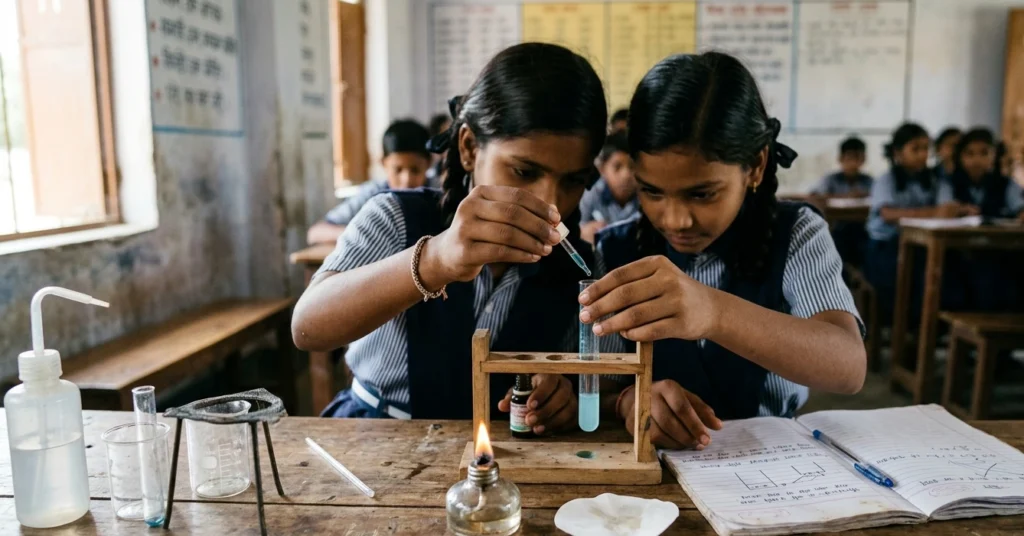
This approach is known as experiential learning. Often described simply as “learning by doing,” it encourages students to engage directly with experiences rather than relying only on lectures, textbooks, or memorization.
Experiential learning does not mean replacing classroom teaching with activities. Instead, it brings experience into the learning process so that students can connect concepts with observation, practice, problem-solving, reflection, and real-world situations.
India’s National Education Policy (NEP) 2020 places significant emphasis on experiential, hands-on, discovery-based, and competency-oriented learning. Government initiatives have subsequently translated these principles into different educational programs and pedagogical approaches.
For students, this can make learning more relevant and engaging. For teachers, it creates opportunities to move beyond simply delivering information and instead guide students as they explore questions, test ideas, make mistakes, and develop their own understanding.
What Is Experiential Learning?
Experiential learning is an approach in which learners gain knowledge and skills through meaningful experiences, followed by observation, reflection, and application.
The experience could be a science experiment, a field visit, a community project, an art activity, a school garden, a model-making exercise, a local survey, or a practical problem-solving task. What makes the activity experiential is not simply that students are doing something with their hands. The activity should be connected to a learning objective and give students an opportunity to think about what they observed and what they learned.
This distinction is important.
A student making a model without understanding its purpose may simply be completing an assignment. A student designing a model to investigate how a bridge distributes weight, testing different designs, recording observations, and discussing why one design worked better is engaging in a deeper learning process.
NCERT’s guidance on science education similarly highlights experimentation, observation, locally significant projects, and learning by doing as ways of developing conceptual understanding and skills.
Experiential learning can therefore combine several stages:
Experience → Observation → Reflection → Understanding → Application
The process allows students to move between theory and practice instead of treating them as separate parts of education.
Why Learning by Doing Matters
Traditional classroom instruction remains important. Students need foundational knowledge, explanations, reading skills, and structured guidance. However, knowledge becomes more useful when learners have opportunities to apply it.
Experiential learning can help students understand why a concept matters rather than simply remembering what it means.
For example, a lesson about water conservation can remain theoretical when students only read about water scarcity. It becomes more tangible when students examine water use in their school, measure consumption, discuss local challenges, and think about possible solutions.
Similarly, learning about biodiversity can become more meaningful when students observe plants and insects in their surroundings, record what they find, and investigate how different species interact with their environment.
The objective is not to turn every lesson into a project. It is to create purposeful opportunities where students can connect knowledge with experience.
Government initiatives around NEP 2020 recognise this connection. The Ministry of Education has reported experiential learning approaches that aim to make learning deeper, meaningful, and relevant while supporting motivation, critical thinking, socio-emotional skills, and lifelong learning.
How Experiential Learning Supports Students
Developing Critical Thinking
Experiential learning gives students opportunities to ask questions rather than simply receive answers.
When students conduct an experiment, investigate a local issue, design a solution, or compare different outcomes, they need to observe evidence and decide what it means. They may initially make assumptions that turn out to be incorrect. Revisiting those assumptions encourages them to think more carefully.
For example, instead of simply learning that plants require certain conditions to grow, students could observe two plants under different conditions, record changes over time, and discuss what their observations suggest.
This kind of learning encourages students to examine evidence, identify relationships, and explain their reasoning.
Connecting Knowledge With Real Life
One of the strongest advantages of experiential learning is its ability to connect academic concepts with everyday experiences.
Mathematics can be connected with budgeting, measurement, design, or data collection. Science can be explored through experiments and observations. Geography can be understood through fieldwork and mapping. History can become more tangible through visits to heritage sites, oral histories, artefacts, and local stories.
This approach can also make learning more accessible to students who struggle to connect abstract concepts with their everyday lives.
India’s PRERANA programme provides an example of this approach. The Ministry of Education describes it as an experiential learning programme that combines hands-on activities, technology, cultural heritage, reflection, storytelling, site visits, and other experiences to help students connect learning with their surroundings.
Building Collaboration and Communication Skills
Many experiential activities involve working with others. Students may have to divide responsibilities, discuss ideas, listen to different perspectives, present their findings, and work through disagreements.
These experiences develop skills that are difficult to build through memorisation alone.
A group project, for instance, may require one student to collect information, another to organise data, another to prepare a presentation, and others to explain the findings. The academic outcome matters, but the process also develops communication, cooperation, responsibility, and time management.
PRERANA’s experiential framework includes activities such as presentations, discussions, hands-on work, personal reflection, and collaborative experiences, illustrating how different forms of participation can be combined within a learning journey.
Encouraging Curiosity and Creativity
Curiosity often begins with a question.
Why does this happen? Can we build it differently? What would happen if we changed one part? Is there another way to solve the problem?
Experiential learning creates space for these questions. Students are not always expected to arrive at the same answer through the same process. Instead, they can explore possibilities, test ideas, make adjustments, and learn from unsuccessful attempts.
This is particularly valuable when students work on open-ended projects. Creativity becomes part of the learning process rather than something reserved for art or extracurricular activities.
Experiential Learning in Indian Education
The idea of learning through experience is increasingly visible in India’s education policy and practice.
NEP 2020 calls for a shift towards more experiential, play-based, discovery-based, and activity-oriented learning. The Ministry of Education has highlighted approaches including art-integrated education, sports-integrated education, storytelling, toy-based pedagogy, experimentation, and hands-on learning.
NCERT’s work also reflects this direction. Its guidance for science education emphasises experimentation and locally relevant projects, while its materials on art-integrated learning describe experience as an important component of meaningful learning.
PRERANA offers another example of how experiential learning can be structured beyond a conventional classroom. Its programme combines heritage exploration, technology, hands-on activities, reflection, presentations, local stories, and field visits. Students are also encouraged to take their learning forward by developing creative solutions to everyday problems.
These approaches show that experiential learning can take many forms. It does not depend on expensive technology or elaborate facilities. A meaningful experience can begin with the resources already available in a school, neighbourhood, or local environment.
Examples of Experiential Learning
Experiential learning can be adapted to different ages, subjects, and educational settings.
A primary classroom might use a simple gardening activity to help children understand plant growth. Older students might investigate local water quality or study household energy use as part of a science project.
History students could document stories from older members of their community, while geography students could create maps based on field observations. Mathematics students could analyse real-world data, and language learners could develop interviews, presentations, or community newsletters.
Technology can also expand these opportunities. Students can use digital tools to document observations, create presentations, analyse information, or design solutions. However, technology itself is not what makes the learning experiential. The important element is the meaningful engagement with a question, problem, experience, or task.
This is consistent with the approach seen in PRERANA, where technology is combined with hands-on activities, cultural experiences, reflection, and real-world exploration rather than being treated as an end in itself.
Financial education can also become experiential when students work with real-life examples such as creating a simple monthly budget, comparing everyday expenses, setting a savings goal, or understanding how financial decisions affect future choices. This connects classroom concepts with practical decision-making and reinforces the importance of financial literacy as a life skill
The Role of Teachers in Experiential Learning
Experiential learning does not reduce the importance of teachers. In many ways, it requires teachers to take on a more active role as facilitators, guides, and observers of student learning.
A teacher can design an experience around a clear learning objective, provide appropriate instructions, ask questions, encourage students to explain their thinking, and help them connect their observations with broader concepts.
Reflection is especially important. After an activity, students should have opportunities to discuss what happened, what surprised them, what they would change, and how the experience connects with what they already know.
Without reflection, an activity can remain just an activity. Reflection transforms experience into learning.
Teachers also need to consider differences among learners. Not every student learns in exactly the same way, and experiential activities should provide different ways to participate and demonstrate understanding.
Making Learning More Meaningful
Experiential learning is not a replacement for textbooks, classroom teaching, assessment, or structured knowledge. Instead, it can complement these approaches by giving students opportunities to apply and deepen what they learn.
A well-designed learning experience does not need to be complicated. Sometimes the most effective activity begins with a simple question from the world around the student.
How much water does our school use?
What plants grow in our neighbourhood?
How does a local business manage its expenses?
Why does a particular structure remain stable?
What stories do older members of our community remember?
Questions like these can turn familiar surroundings into learning environments.
This approach also connects with the broader goals of Education at Ramyanti Foundation, where education can be understood not simply as the accumulation of information but as a means of developing knowledge, skills, curiosity, and the confidence to engage with the world.
Experiential learning can also complement digital learning. As explored in Digital Literacy in the 21st Century, students need the ability to use technology thoughtfully. Combining digital tools with practical experiences can help learners move from consuming information to applying it.
At the same time, meaningful experiential education depends on access to quality learning opportunities. The challenges discussed in Education Challenges in Rural India remind us that educational innovation must also consider differences in infrastructure, resources, teacher support, and access.
Learning Through Experience for a Changing Future
The world students will enter after school is likely to continue changing rapidly. New technologies, evolving workplaces, environmental challenges, and social transformations will require people who can learn continuously and apply knowledge in unfamiliar situations.
Experiential learning can help develop some of these capacities by encouraging curiosity, adaptability, collaboration, critical thinking, and problem-solving.
It also reinforces an important idea: learning does not stop when a lesson ends. Students can learn from observation, experimentation, mistakes, conversations, communities, and the world around them.
India’s education reforms increasingly recognise the value of this broader approach. Through experiential, competency-based, discovery-oriented, and hands-on learning, students can be given more opportunities to connect knowledge with real situations and develop skills alongside academic understanding.
The future of education does not have to be a choice between traditional knowledge and practical experience. The strongest learning environments can bring both together-giving students the foundations they need while also helping them explore, question, create, and apply what they know.
Learning That Continues Beyond the Classroom
Learning becomes powerful when students can see its relevance in the world around them. Experiential learning creates that connection by giving learners opportunities to explore ideas through direct experience, reflection, collaboration, and practical application.
For schools and teachers, this means looking for meaningful ways to bring real-world contexts into education. For students, it means recognising that valuable learning can happen through curiosity, experimentation, observation, and participation.
As education continues to evolve, learning by doing can play an important role in helping students become not only knowledgeable, but also thoughtful, capable, adaptable, and lifelong learners.
References
- Ministry of Education, Government of India – NEP 2020 / Experiential Learning
https://www.dsel-education.gov.in/static/uploads/2026/07/acd5cc42e662ae55f66f419ee6db4b4f.pdf - NCERT – Rashtriya Avishkar Saptah Guidelines
https://ncert.nic.in/desm/pdf/Rashtriya_Avishkar_Saptah_eng.pdf? - Ministry of Education – Toy-Based Pedagogy / Experiential Learning
https://www.education.gov.in/ - PRERANA – Experiential Learning Programme, Ministry of Education
https://prerana.education.gov.in/Experiential-Learning.html - PRERANA – Programme Structure
https://prerana.education.gov.in/preranav1/program-structure.php